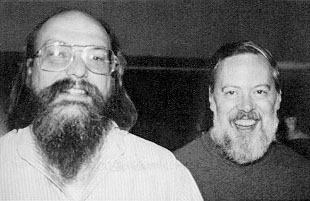
Dennis Ritchie created the C programming language between 1971 and 1973 at Bell Labs. He also co-created Unix with Ken Thompson. These two contributions — C and Unix — are arguably the most influential software achievements of the 20th century.
Ritchie was quiet, modest, and deeply technical. While Steve Jobs's death in October 2011 made global headlines, Ritchie's death just eight days later was barely noticed outside the tech world — despite the fact that virtually every device Jobs ever created ran on software built with Ritchie's language.
Rob Pike (co-creator of Go, colleague at Bell Labs) wrote: "Dennis was the father of the C programming language, co-inventor of Unix, and essentially the founder of the world of modern computing as we know it."
Ken Thompson is one of the greatest programmers who ever lived. He designed and implemented the original Unix operating system, created the B programming language (C's predecessor), co-invented UTF-8 encoding with Rob Pike, designed the Plan 9 operating system, and co-created the Go programming language at Google.
Thompson wrote the first Unix kernel, the first Unix shell, and many of the core Unix utilities in just a few weeks on a PDP-7 in 1969 while his wife was on vacation. His productivity was legendary — he could write more working code in a weekend than most teams could in a month.
While Ritchie created C, Thompson's Unix provided the context that made C necessary and successful. Without Unix, C would have been just another systems language. Without C, Unix would have been trapped on one machine.
Brian Kernighan did not create C, but he arguably did more than anyone to teach the world how to use it. He co-authored "The C Programming Language" with Ritchie in 1978 — universally known as "K&R" — which became the defining text for a generation of programmers.
Kernighan is credited with writing the first "Hello, World!" program (in a 1974 Bell Labs internal memo about B), naming Unix, and co-creating AWK (with Aho and Weinberger). He also wrote the first documented "Hello, World!" in C in the K&R book, establishing the tradition that every programming tutorial begins with printing a greeting.
He is currently a professor at Princeton University, where he teaches computer science and continues to write influential books. His writing style — clear, concise, example-driven — set the standard for technical communication.
Rob Pike worked at Bell Labs on Unix, Plan 9, and Inferno. With Ken Thompson, he co-created UTF-8 encoding (the character encoding used by virtually the entire internet). At Google, he co-created the Go programming language with Thompson and Robert Griesemer.
Pike's influence on C is indirect but significant: he helped design the systems and standards (Plan 9, UTF-8, Go's C heritage) that kept C's philosophy alive. His "Notes on Programming in C" is one of the most-cited style guides for C programmers.
C was not created in isolation. It was born at Bell Telephone Laboratories in Murray Hill, New Jersey — arguably the most productive research lab in human history. Bell Labs also produced: the transistor (1947), information theory (Shannon, 1948), the laser (1958), the cosmic microwave background radiation discovery (1965), Unix (1969), C (1973), C++ (1979), and Plan 9 (1992).
Nine Nobel Prizes have been awarded for work done at Bell Labs. The environment combined pure research freedom with practical engineering needs from AT&T. C emerged from this culture: theoretically sound (Ritchie had a PhD in applied mathematics from Harvard) but relentlessly practical (it needed to compile an OS kernel).